Showing posts with label the southwest. Show all posts

Wednesday, 26 May 2010

The Bolivian Salt Flats - Part 2

Day two started with a half past six breakfast, which oddly consisted of tea and stodgy cake, then back on the road by seven, leaving the salt flat and salt hotel behind us. We headed for the Bolivian desert and there were plenty of miles to cover so we stopped at the next village along for some supplies - in the form of more beer. Drinking a few cans while travelling in the 4x4 was an inspired idea. I was glad to see our driver didn't partake despite Brice offering!

Ah, yes. It's about time I introduced our splendid group. Let's see, we had Brice, who I just mentioned. He was always on-hand with the bottle of red wine whenever we ate (good man), lives in Brittany and smokes far too much for someone of just twenty-three years. Then, his friend Pierre, the same age and also from Brittany. He has spent time in Ecuador practicing Osteopathy. He speaks great Spanish and was very much the joker of the group. Next we had Florianne, 25, from Marseilles who is an animator by profession and was on hand with the candles when the electricity ran out. And last but not least her friend Cecilia, 21, also an animator back in France and who was cheerful and generally a pleasure to be around. There.
It was our turn to be in the back of the jeep. It was indeed lacking in legroom, however, despite the many miles we travelled on day two, we frequently stopped to admire views and take photos and stretch our legs. This day would mainly be about visiting a series of lakes. And on some of the lakes we got the rare chance of seeing flamingos! At one such lake we stopped and while Elias, our driver prepared lunch, we photographed the pink-coloured birds and the magnificent reflection of the mountains in the background. 

Lunch, by the way, was delicious. I wasn't expecting much, it being served out of the back of the jeep in the middle of nowhere. But we had bread-crumbed chicken, potatoes, rice and salad. And, of course, wine!
With another day of sightseeing drawing to a close it was time to head for our second accommodation for the trip. Set around a lake, this hospedaje wasn't made of salt but was on par in terms of facilities. It was basic, as expected. But again, it did have electricity so we weren't in the dark after sundown. But what proved challenging was the temperature. It is difficult to tell exactly how cold it is. Having spent a fair part of our travelling days in hot places, I suspected I had become a little sensitive to a bit of cold. Or soft, you could say! And up at around 4000m the wind can really get to your bones. However, we were informed that it was very close to zero degrees celsius and by nightfall temperatures would reach a chilling minus sixteen! The thing here is that we did not have any form of heating. I'm pretty sure I've never felt as cold as I did that night. After playing poker and struggling to hold the playing cards wearing gloves, we called it a night and went to bury ourselves in sleeping bags and blankets before a five in the morning wake up call. Yeah, that was going to be a joy!
It was indeed a painful experience to get up at such an early hour and in such cold. Our guide popped his head in and informed us he was loading the car. I'm sure he hadn't slept without heating. The evening before I'd seen the next house along with smoke bellowing from its chimney giving me visions of all the guides curled up around a big fire like dogs. 
Day three of our trip would be short but sweet. In the dark we drove along until we reached an area full of geysers. With the sun just coming up we had a good old nose around the dozens of holes with hot gases rushing up from them. It was amazing. Pretty smelly though. You could only endure the stench of rotten eggs for so long! 

From here it was on to the thermal pool, and breakfast. When we pulled up the pool had many a white-skinned human in it already. The air temperature was still very very low, but most had braved it, stripped off and jumped in the warm water. All very well, but getting out again would be a tough task. Pierre and Bryce talked for a while and decided to go for it. Sophie and Floriane stayed in the car with a cup of tea and I copied Cecilia and dipped my feet in the pool, as a half measure. In my defense my towel was packed away amongst the bags on top of the jeep. 
After breakfast we headed for the last stop, Laguna Verde - the lifeless lake laden with arsenic. If you catch it at the right time it is green, as its name suggests. This day it only had a slight tinge of green, but still a magnificent sight. From here it was onwards to the Chilean border where we would go our separate ways, the French heading back to Uyuni and us into Chile. 

The cold temperatures was definitely the main challenge of the trip, not to mention second having to converse in Spanish with our new friends - all good practice. But, as I write from the comfort of my warm hotel room back in civilisation, I am so glad we chose to take the three day trip. The salt flats were out of this world, but the Bolivian desert, with its mountains, geysers and lakes were equally as impressive.

Tuesday, 25 May 2010

The Bolivian Salt Flats - Part 1

We set off mid-morning, once our Land Cruiser had been loaded up with luggage, fuel, food, plus the four French people that would make up our group. A standard three day tour will take six people and they manage to fill the cars, no doubt by tempting lone travellers with rock bottom prices at the last minute. I'd say there is something to be said for standing on the street at five to eleven looking disinterested. Its bound to get you a great bargain!
Anyway, six people plus driver is just about comfortable in the Toyota 4x4 - though the two in the back have limited leg space. But, as all the tours offer the same transport, it is obvious that these machines are the best for the job. Not long had we been travelling out of town had the bumpy terrain started. But it provided no test for these vehicles. It was almost as smooth as a Rolls Royce on new tarmac.
First stop, a train graveyard - quite a spectacular sight, just on the outskirts of Uyuni. The British built railway had once been used to transport minerals from the nearby mountains and transport them to Chile and the coastal ports. However, since depletion of mineral reserves in the 1940's, the trains were abandoned producing an eery train cemetery - and something for us to climb all over and take pictures. Glad I'd had my tetanus booster! Rumour has it that a proper museum is planned for the site, but for now you're invited to climb aboard and pretend you're a train driver from the late nineteenth century!
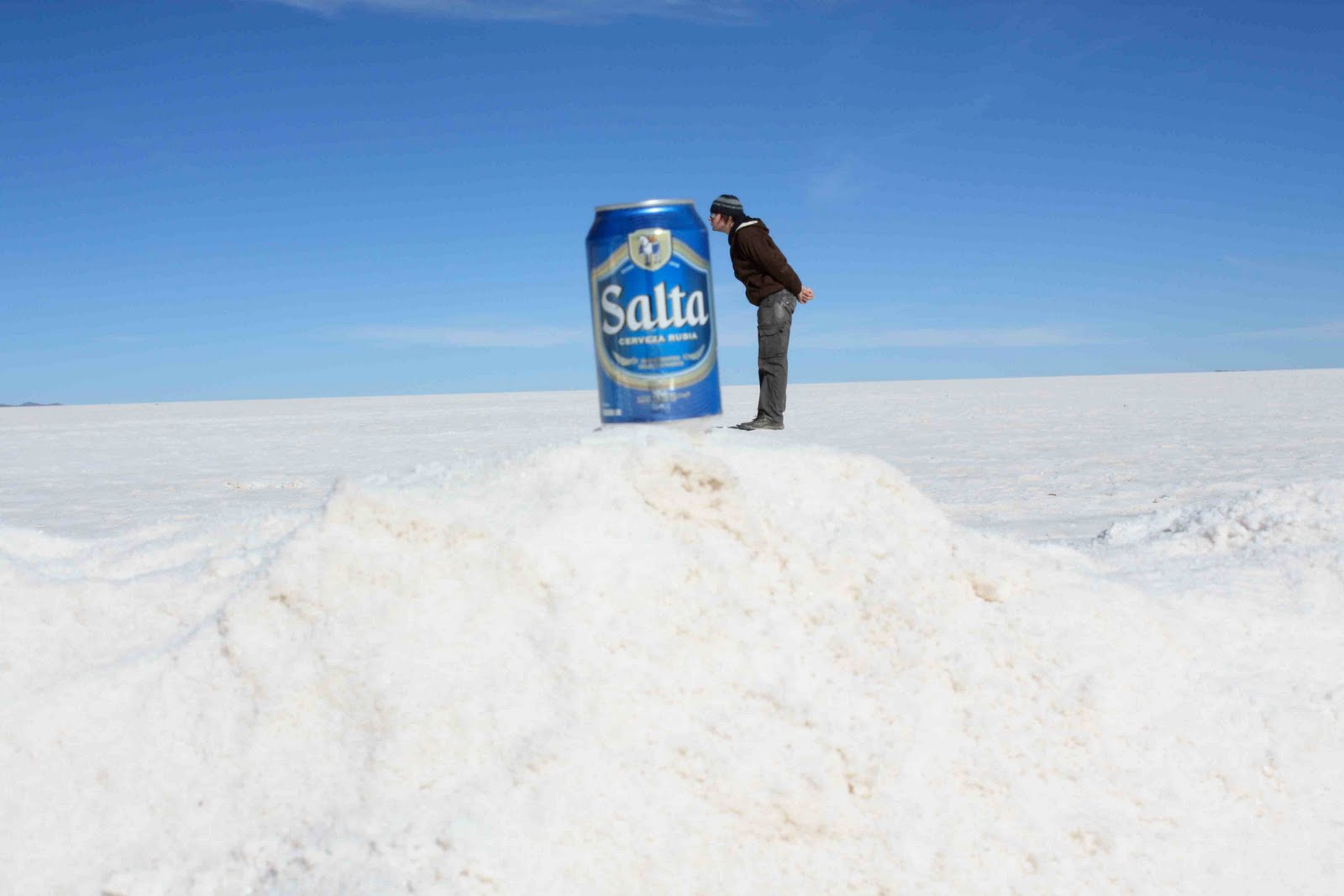
Next, the reason we came. The Salar. It is nothing short of incredible. The flat white surface of salt stretches out as far as the eye can see and the contrast between that and the brilliant blue Bolivian sky makes it something really special and unique. I doubt there is anything on earth quite like it. Of course, it presented the opportunity to have some fun creating odd perspectives with the camera.
Soon after having messed around posing with some 'huge' cans of beer, it was lunch. Our guide set out an impressive array of food, and the French cracked open a bottle of red. It was good fare and fantastic surroundings - although four of our group would have been happier to finish the meal with some strong cheeses.
The Salt Flat isn't all, well... flat. There is an island to see, formerly the top of a submerged volcano back when the salt flat was a prehistoric lake. The island, called Isla de Pescado apparently because of its likeness to a fish from a distance, has some large cactuses growing on it. But for me the thing to do was to climb up on top of the island and get some more views of the flats. Like others around me, I couldn't stop taking photos. Thank goodness for digital.

Day one was almost over. Not a particularly strenuous one, I know. But it was a welcome change to be driven around and not be expected to hike for three hours or climb up to a mountain summit. Plus the French (don't worry, I'll get around to introducing them) had a supply of beer and every so often one would be passed around the car as we sped over the crusty white salt surface. Realising we'd missed a trick, we stocked up ourselves whilst stopping at a small village.
As the sun started to set and the last dregs of Pacena were being swallowed, we pulled up at a little community of houses on the edge of the plain. Our home for the night was to be made of salt. Yes, that's right, there is so much salt in these parts, they build hotels from the stuff. And its no shoddy job either. These blocks have been professionally cut and look just like they are made from stone. Only on close inspection can you see the shimmering crystals.
We were told that of the two nights on the trip, the stay at the salt hotel would be the more luxury of the two. OK, they had a shower (which was actually out of service on this occasion) but it was hard to see how much more basic a hotel stay could be. I suppose electricity could be classed as a luxury. But after dinner and a few games of cards, one by one the lights went out and the water was turned off. Thankfully our French pals had brought along head lamps and candles. Well done them! We would have really struggled otherwise.

To be continued...

Monday, 24 May 2010

Bolivia's second 'Death Road'?

I couldn't tell you exactly how many miles we have travelled since arriving in Mexico city last October. But I'm fairly sure that I can now tell you where the most difficult of those miles occurred. After spending time in the plush and serene surroundings of Tarija, the bus ride north towards Uyuni served as a reminder that Bolivia is amongst the poorest of the countries we've visited.
To get to Uyuni from Tarija requires taking an overnight bus journey to Tupiza and then a further seven or so hours on a bus from there. I no longer find it hard to psyche myself up for these journeys. You soon know what mindset you need to be in to avoid the frustrations of stops in the middle of the night, winding roads, crying children and drivers who want to emulate Ayrton Senna. What works for me is having plenty of battery on the mp3 player, your own supply of loo roll, a sleeping bag and a bottle of water. Then, sit back and see what happens. Who knows, you might fall asleep!

Well, none of that was going to make a difference this time. After settling in on a battered, grubby bus with broken seats that stayed reclined, we pulled out of Tarija. The lights went out at all of half past eight and the bus turned off the main road and onto a dirt track. The road to Tupiza is all stoney track and no tarmac. 

To say that the track was bumpy is an understatement. Right from the off we were thrown all about the place and frequently my body left the seat several inches and then crashed back down again. Hardly the best environment to catch some sleep. This was to be the state of things until we arrived in Tupiza in the morning. The road is said to be a fairly dodgy one too and perhaps it was better that the dark prevented the sight of any sheer drops.

At half past ten we made a stop in a town I'll call World's End, or Termina El Mundo if you like. It was cold, dark, the wind was blowing a gale (containing lots of dust) and there were just a couple of buildings around, one a restaurant. Some got off for a meal. We only wanted to use the facilities as in Bolivia they don't provide toilets on buses. The trouble is, they're also not concerned with stopping somewhere with a toilet. The restaurant owner claimed not to have any toilets and told us to go outside. Nice. 
After a further six hours of being thrown around inside a bus, we arrived in Tupiza. Second to a lack of hygiene, Bolivia does not synchronize its buses. It was five in the morning and the onward bus to Uyuni was scheduled to leave at ten o'clock. What else to do in the cold and dark than to unroll the sleeping bag and curl up on a bench. See, I told you it was part of the essential kit list! 

After sunrise we discovered that Tupiza didn't offer anything by way of places to grab a bit of breakfast, so we gate-crashed a hostel and got them to feed us some bread and a cup of tea. 
The next leg of the journey was very long and very cramped and involved a stop at Atocha, a mining town surrounded by desert and mountains. This surely is about as rural as it gets in Bolivia. Again there was a harsh wind blowing dust around and anything that wasn't nailed down. It was an interesting place to see but unfortunately none of the restaurants or market stalls had any food to sell. I think it's the first time I've encountered a place that has turned away a bus-load of travellers. Surely a bus stops here every day about the same time. Perhaps the thing to do would be to get some food on the go?

As a rule, an overnight bus will get in early and a day bus will get in late. We reached Uyuni by around six o'clock tired and in need of a shower. Uyuni is a basic town that is full of tour agencies but it has many restaurants plus a few stylish pubs. The trick is staying warm. I'm not sure if a lack of sleep will generally make you feel the cold more, but I wore as many layers as I could and went about getting myself a bowl of soup to huddle over!

The roads to Uyuni are never going to compete with the Death Road near La Paz, but perhaps it is a stretch that could be dubbed "Make-you-feel-like-death road"!

Friday, 21 May 2010

Tarija - ahem, and an important football match


If you're going to be turfed out of a bus somewhere at five o'clock on a cold morning, you could do worse than Tarija. After hanging around the (outdoor) bus station chatting to a fellow Brit, who had a flight to catch from Rio and not much time to get there, we went into town to use up some more hours before we could reasonably turn up at our hotel. Luckily an up-market restaurant opened its doors and let us in for breakfast - it's becoming a familiar story!
However, being in Tarija doesn't feel like being in the rest of Bolivia. It is home to Bolivia's wine region and the wealth created from that shows. But it's not just that. You could quite easily be in Spain. The streets are peaceful and lined with trees, the climate is very Mediterranean and of course there is the architecture. When the Tarija department won independence from Spain in 1817, it declared itself an independent country before later joining Bolivia, and it feels like the latter never happened.

I discovered another reason that Tarija is different, and not just from the rest of Bolivia, but perhaps, the rest of Latin America. Our second day there was a Saturday. But not just any Saturday. It was FA Cup Final Saturday and I had a keen interest in the outcome. Up until now, if you wanted to watch football you couldn't help but fall into a place that would be showing the game you wanted. The time difference didn't help, but I was pretty confident that I could pick a bar in town and settle in for ninety minutes - I don't ask for much in life!
But it was not to be as easy as that. The two trendy bars on the main square were, well, a little too trendy. They didn't even have television screens. We went in search of somewhere and followed advice from locals, only to be pointed back to the square where we'd started. Oh well, my luck of catching games had to end sometime. We took one last walk up a side street and happened upon a cafe with a television. I approached the owner and asked if he had cable TV, expecting the answer to be no. But instead, it was a yes! He generously surrendered the remote and I found the channel with just a few minutes to spare. We sat down and enjoyed empanadas for breakfast - oh yeah, and a historic win!

So, the people of Tarija are extremely kind and friendly, although perhaps not that fussed about football. Afterwards the cafe owner suggested a few sights we should see. But first it was off to the zoo to see what they kept there. Impressively they had a good range of animals, including some very sad-looking lions and leopards. But then, do lions ever look that happy behind bars?

Tuesday, 18 May 2010

Sucre - Bolivia

Sucre is the most modern place I’ve seen so far in Bolivia. It is Bolivia’s other capital and is home to a considerably slower pace of life than La Paz. This can be just what you need. After all, as much as I enjoyed La Paz and all of its energy, I wouldn’t have wanted to stay there longer than the week that we did. Sucre would be a good place to study, should you want to learn a bit of Spanish for example. We studied in Cuenca, Ecuador and there are many similarities between the two cities. It is also lower than Potosi, which meant it was much warmer, thankfully.
Sucre has a rich history dating back to the Spanish colonies and the architecture from this time remains. It is what makes the city a pleasure in which to stay. Rarely in Latin America does anything as aesthetically pleasing replace lost architecture. The same could be said of many places around the world but it has to be more evident in poorer countries. Luckily here there is still plenty to admire.
I have no adrenaline packed adventures to report this time, however we did take a trip to see some dinosaur footprints. Taking the “Sauro Tours” truck from the city centre (why take a taxi when you can be transported in open vehicle with a dinosaur head stuck to the front – it provides the locals with something to laugh at!) we went to a cretaceous exhibition, on the same site as a concrete plant. You actually have to walk into the concrete plant to gain access to the exhibition, but as we learned, the concrete plant is responsible for the discovery of the footprints themselves.

I expected some big paw prints to be fenced off for us to look at, and maybe even step in. This is Bolivia, after all. In fact, the footprints can be seen from a viewing balcony on a vertical wall opposite. My first thought was how the prints came to be on such vertical face. This was soon explained by our guide, but in Spanish at a ridiculously fast pace. No good. Much too fast for me. I went off to the office and came back with an English-speaking guide. I didn’t want to miss any important dino details!

With anything dinosaur-related, it is mind boggling when considering the time scale involved – millions of years. We’ve been around for the blink of an eye in comparison, yet we think we know the world’s problem. I’m one of those who believes that as soon as we get the “climate change” problem sorted, the next ice age will swiftly be along to finish us off!
So, here’s the theory. 68 millions (or so) years ago, when the Andes didn’t exist and South America was nice and flat, the oceans washed in and created lakes, or more like puddles to dinosaurs. They walked across these and left their footprints behind in the limestone mud. Some went in straight lines. Some in circles (not very clever), and some got halfway across, changed their mind and wandered back the way they’d come. Since then, tectonic plates have moved about and mountains have formed, pushing the once flat land with footprints up through ninety degrees to a vertical plane. As a result they have been covered and preserved by layers of sediment and earth…until recent times.

Somehow, when the cement company were taking layers off of the hill with large JCBs, they found the footprints without spoiling them. The scientists were called in and a limit was put on how much further the hill can be excavated for cement purposes. Unfortunately there are not the resources to protect the prints and it has been deemed too late to prevent them washing away within the next eight years or so. But casts have been taken and you can take a good look at them in the museum.
Taking the dino truck meant we were only granted an hour at the exhibition. I would have liked a little longer and had we known, a taxi may have been the better option. When you stop and think about the existence of dinosaurs on earth, even for five minutes, it gets the brain bubbling away. That makes a trip to see some evidence well worth it in my book!

Sunday, 16 May 2010

The Potosi Mines - Bolivia

When I read one description of the Potosi mines I wasn’t all that keen on visiting. It said they have been described as “the mouth of hell” and that visitors should be aware that a trip down into them is both physically and emotionally draining. However, out of sheer curiosity (Sophie’s, not mine!) we made the long journey south from La Paz. An overnight bus to pretty much any destination in Bolivia will get you in at about 6am. I have thought a lot about why they schedule them like this. Is it because some people are doing a long commute and need to get to where they’re going in time for work? Do the bus companies prefer to avoid the morning rush hour? Surely not, given that the bus terminals are usually on the edge of town. The trouble is, they often run ahead of schedule. The 6am arrival time clearly has some margin in it meaning that you’re likely to rock up at anything from five o’clock in the morning. You’d think a bus getting in early is a good thing. Well, with the kind of temperatures you get in the Bolivian mountain range, it’s not. You arrive to freezing pre-dawn temperatures (at least that’s how it feels) and have nowhere to go because there isn’t a café or a restaurant open.
This was the scenario for Potosi. A taxi driver took us into town on the promise that there would be a café open at seven in the morning. It turned out there wasn’t. He would have said anything to get the fare. The only action in town was a few folks at the market setting up their stalls.

Around eight in the morning the owner of a place called The Koala Café opened its doors and let in two shivering souls with heavy backpacks (us). We ordered some tea and attempted to thaw our bones.
Who should walk in half an hour later but Bart, our one-time fellow student at a Quito language school. He, like us, had also been travelling south. I was relieved to find he had shaken off the advances of my Spanish teacher – not before she had stalked him all the way to Lima!

Bart had things sorted. He had a hostel and had booked himself on a tour of the Potosi mines leaving at 9am, along with an Englishman called Mohammed. Feeling not so fresh after our overnight bus journey, we decided to join them. After all, what would have been the point in going for a shower only to enter a mineshaft half an hour later?
To enter the Potosi mines you need more than overalls, boots and a hard hat. You need gifts for the miners. The mines at Potosi, although no longer rich with silver or tin still contain around 10,000 miners and they fuel themselves on coca leaves and 94% alcohol – called Bolivian whiskey. The only other thing they appreciate being given is dynamite. What better present to give a drugged-up drunk person in a confined space?

Buying alcohol and coca and then dynamite a few doors up was a surreal experience. The dynamite, we were assured, would pose no threat without the fuse and detonator attached. Still, with all three thrown into a plastic bag, I treated it with caution. Off we went to the mines.
Our guide, himself a one-time miner before he saw a better life for himself in tourism, took us in and down into the depths of the earth. It is warm down there. He explained what the smears of blood on the walls were. Not that of unsuspecting tourists, but of unsuspecting llamas (or even more disgusting, llama foetuses) that had been sacrificed and offered to the Tio – their devil-like God, if that makes sense. For the mining world apparently belongs to the devil and in return he will give you up some silver or mineral in return. I think at this point I needed some coca or alcohol to appreciate the symbolism in full.
We came across miners from time to time. They were small people who didn’t say a lot. Being small is definitely an advantage in a mine, as you can imagine. It wasn’t so easy for a 6ft 6 Dutchman called Bart! However, we all made it down a couple of levels (there are nine in total) and survived some frighteningly rickety ladders in the process. Eventually we came to a corridor that even the heavily doped miners in front advised was too dangerous. They were propping up the tunnel with planks of wood and said it was too hazardous for us. We turned around and headed back, not before giving up some of the last of our dynamite.
Before entering the mines I had thoughts of what a terrible job being a miner would be and it seemed almost unbelievable that the UK had a large mining workforce as recent as the 1980s. Coming out of the mines I felt lacking in compassion for the miners. Perhaps that was due to an insight into their mindset – apparently it is an ‘every man for himself’ one where even murder has been covered up as an accident. Three years or so ago, it was also good business, when a new but short-lived seam of tin was found. At this time, miners could be seen driving about town in Hummers, which I would have loved to have seen. With a poorer market for tin and minerals and with the mountain not yielding as much at this time, it is not happy days for the miners. They believe that they will find more the deeper they go. UNESCO believes that the whole thing will literally collapse and is campaigning against the constant hunt for the legendary pot of silver, apparently hidden deep within the bowels of the earth.
We didn’t get to explode any dynamite within the mines. That’s probably for the best. However our guide had kept one stick up his sleeve, which once assembled and lit, we got to play with – it had a long fuse, don’t worry, Mum! He walked twenty feet away, planted it and we waited for the explosion. We waited and waited. They say don’t return to a lit firework and that must be especially so for dynamite. BANG! It was a deafening noise and a vibration of the earth accompanied by a puff of smoke. Yes, that was best done out in the open! Occasionally Latin America dishes up something that you just can’t do in Europe and this tour was definitely one of them!