Showing posts with label uyuni. Show all posts

Wednesday, 26 May 2010

The Bolivian Salt Flats - Part 2

Day two started with a half past six breakfast, which oddly consisted of tea and stodgy cake, then back on the road by seven, leaving the salt flat and salt hotel behind us. We headed for the Bolivian desert and there were plenty of miles to cover so we stopped at the next village along for some supplies - in the form of more beer. Drinking a few cans while travelling in the 4x4 was an inspired idea. I was glad to see our driver didn't partake despite Brice offering!

Ah, yes. It's about time I introduced our splendid group. Let's see, we had Brice, who I just mentioned. He was always on-hand with the bottle of red wine whenever we ate (good man), lives in Brittany and smokes far too much for someone of just twenty-three years. Then, his friend Pierre, the same age and also from Brittany. He has spent time in Ecuador practicing Osteopathy. He speaks great Spanish and was very much the joker of the group. Next we had Florianne, 25, from Marseilles who is an animator by profession and was on hand with the candles when the electricity ran out. And last but not least her friend Cecilia, 21, also an animator back in France and who was cheerful and generally a pleasure to be around. There.
It was our turn to be in the back of the jeep. It was indeed lacking in legroom, however, despite the many miles we travelled on day two, we frequently stopped to admire views and take photos and stretch our legs. This day would mainly be about visiting a series of lakes. And on some of the lakes we got the rare chance of seeing flamingos! At one such lake we stopped and while Elias, our driver prepared lunch, we photographed the pink-coloured birds and the magnificent reflection of the mountains in the background. 

Lunch, by the way, was delicious. I wasn't expecting much, it being served out of the back of the jeep in the middle of nowhere. But we had bread-crumbed chicken, potatoes, rice and salad. And, of course, wine!
With another day of sightseeing drawing to a close it was time to head for our second accommodation for the trip. Set around a lake, this hospedaje wasn't made of salt but was on par in terms of facilities. It was basic, as expected. But again, it did have electricity so we weren't in the dark after sundown. But what proved challenging was the temperature. It is difficult to tell exactly how cold it is. Having spent a fair part of our travelling days in hot places, I suspected I had become a little sensitive to a bit of cold. Or soft, you could say! And up at around 4000m the wind can really get to your bones. However, we were informed that it was very close to zero degrees celsius and by nightfall temperatures would reach a chilling minus sixteen! The thing here is that we did not have any form of heating. I'm pretty sure I've never felt as cold as I did that night. After playing poker and struggling to hold the playing cards wearing gloves, we called it a night and went to bury ourselves in sleeping bags and blankets before a five in the morning wake up call. Yeah, that was going to be a joy!
It was indeed a painful experience to get up at such an early hour and in such cold. Our guide popped his head in and informed us he was loading the car. I'm sure he hadn't slept without heating. The evening before I'd seen the next house along with smoke bellowing from its chimney giving me visions of all the guides curled up around a big fire like dogs. 
Day three of our trip would be short but sweet. In the dark we drove along until we reached an area full of geysers. With the sun just coming up we had a good old nose around the dozens of holes with hot gases rushing up from them. It was amazing. Pretty smelly though. You could only endure the stench of rotten eggs for so long! 

From here it was on to the thermal pool, and breakfast. When we pulled up the pool had many a white-skinned human in it already. The air temperature was still very very low, but most had braved it, stripped off and jumped in the warm water. All very well, but getting out again would be a tough task. Pierre and Bryce talked for a while and decided to go for it. Sophie and Floriane stayed in the car with a cup of tea and I copied Cecilia and dipped my feet in the pool, as a half measure. In my defense my towel was packed away amongst the bags on top of the jeep. 
After breakfast we headed for the last stop, Laguna Verde - the lifeless lake laden with arsenic. If you catch it at the right time it is green, as its name suggests. This day it only had a slight tinge of green, but still a magnificent sight. From here it was onwards to the Chilean border where we would go our separate ways, the French heading back to Uyuni and us into Chile. 

The cold temperatures was definitely the main challenge of the trip, not to mention second having to converse in Spanish with our new friends - all good practice. But, as I write from the comfort of my warm hotel room back in civilisation, I am so glad we chose to take the three day trip. The salt flats were out of this world, but the Bolivian desert, with its mountains, geysers and lakes were equally as impressive.

Tuesday, 25 May 2010

The Bolivian Salt Flats - Part 1

We set off mid-morning, once our Land Cruiser had been loaded up with luggage, fuel, food, plus the four French people that would make up our group. A standard three day tour will take six people and they manage to fill the cars, no doubt by tempting lone travellers with rock bottom prices at the last minute. I'd say there is something to be said for standing on the street at five to eleven looking disinterested. Its bound to get you a great bargain!
Anyway, six people plus driver is just about comfortable in the Toyota 4x4 - though the two in the back have limited leg space. But, as all the tours offer the same transport, it is obvious that these machines are the best for the job. Not long had we been travelling out of town had the bumpy terrain started. But it provided no test for these vehicles. It was almost as smooth as a Rolls Royce on new tarmac.
First stop, a train graveyard - quite a spectacular sight, just on the outskirts of Uyuni. The British built railway had once been used to transport minerals from the nearby mountains and transport them to Chile and the coastal ports. However, since depletion of mineral reserves in the 1940's, the trains were abandoned producing an eery train cemetery - and something for us to climb all over and take pictures. Glad I'd had my tetanus booster! Rumour has it that a proper museum is planned for the site, but for now you're invited to climb aboard and pretend you're a train driver from the late nineteenth century!
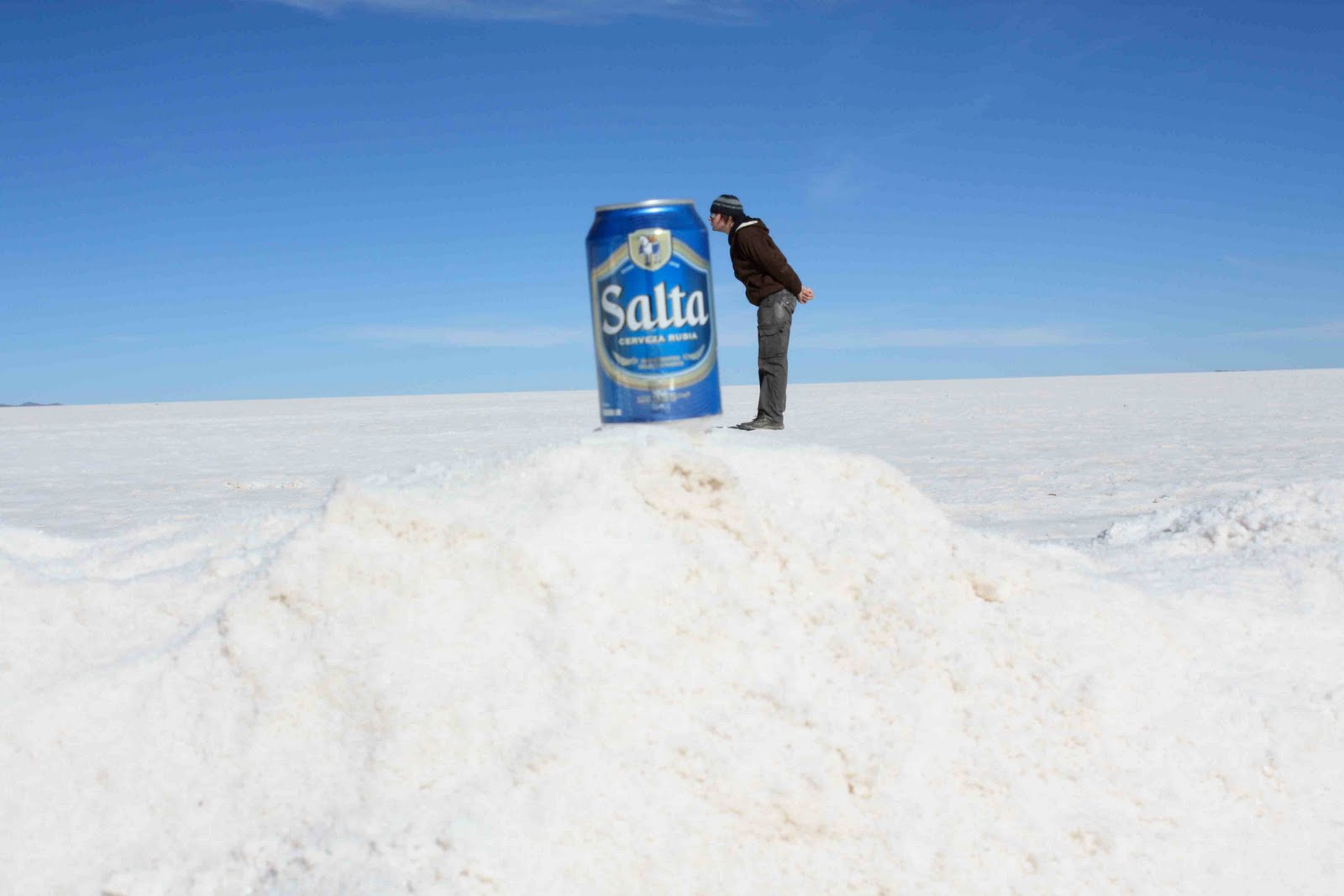
Next, the reason we came. The Salar. It is nothing short of incredible. The flat white surface of salt stretches out as far as the eye can see and the contrast between that and the brilliant blue Bolivian sky makes it something really special and unique. I doubt there is anything on earth quite like it. Of course, it presented the opportunity to have some fun creating odd perspectives with the camera.
Soon after having messed around posing with some 'huge' cans of beer, it was lunch. Our guide set out an impressive array of food, and the French cracked open a bottle of red. It was good fare and fantastic surroundings - although four of our group would have been happier to finish the meal with some strong cheeses.
The Salt Flat isn't all, well... flat. There is an island to see, formerly the top of a submerged volcano back when the salt flat was a prehistoric lake. The island, called Isla de Pescado apparently because of its likeness to a fish from a distance, has some large cactuses growing on it. But for me the thing to do was to climb up on top of the island and get some more views of the flats. Like others around me, I couldn't stop taking photos. Thank goodness for digital.

Day one was almost over. Not a particularly strenuous one, I know. But it was a welcome change to be driven around and not be expected to hike for three hours or climb up to a mountain summit. Plus the French (don't worry, I'll get around to introducing them) had a supply of beer and every so often one would be passed around the car as we sped over the crusty white salt surface. Realising we'd missed a trick, we stocked up ourselves whilst stopping at a small village.
As the sun started to set and the last dregs of Pacena were being swallowed, we pulled up at a little community of houses on the edge of the plain. Our home for the night was to be made of salt. Yes, that's right, there is so much salt in these parts, they build hotels from the stuff. And its no shoddy job either. These blocks have been professionally cut and look just like they are made from stone. Only on close inspection can you see the shimmering crystals.
We were told that of the two nights on the trip, the stay at the salt hotel would be the more luxury of the two. OK, they had a shower (which was actually out of service on this occasion) but it was hard to see how much more basic a hotel stay could be. I suppose electricity could be classed as a luxury. But after dinner and a few games of cards, one by one the lights went out and the water was turned off. Thankfully our French pals had brought along head lamps and candles. Well done them! We would have really struggled otherwise.

To be continued...

Monday, 24 May 2010

Bolivia's second 'Death Road'?

I couldn't tell you exactly how many miles we have travelled since arriving in Mexico city last October. But I'm fairly sure that I can now tell you where the most difficult of those miles occurred. After spending time in the plush and serene surroundings of Tarija, the bus ride north towards Uyuni served as a reminder that Bolivia is amongst the poorest of the countries we've visited.
To get to Uyuni from Tarija requires taking an overnight bus journey to Tupiza and then a further seven or so hours on a bus from there. I no longer find it hard to psyche myself up for these journeys. You soon know what mindset you need to be in to avoid the frustrations of stops in the middle of the night, winding roads, crying children and drivers who want to emulate Ayrton Senna. What works for me is having plenty of battery on the mp3 player, your own supply of loo roll, a sleeping bag and a bottle of water. Then, sit back and see what happens. Who knows, you might fall asleep!

Well, none of that was going to make a difference this time. After settling in on a battered, grubby bus with broken seats that stayed reclined, we pulled out of Tarija. The lights went out at all of half past eight and the bus turned off the main road and onto a dirt track. The road to Tupiza is all stoney track and no tarmac. 

To say that the track was bumpy is an understatement. Right from the off we were thrown all about the place and frequently my body left the seat several inches and then crashed back down again. Hardly the best environment to catch some sleep. This was to be the state of things until we arrived in Tupiza in the morning. The road is said to be a fairly dodgy one too and perhaps it was better that the dark prevented the sight of any sheer drops.

At half past ten we made a stop in a town I'll call World's End, or Termina El Mundo if you like. It was cold, dark, the wind was blowing a gale (containing lots of dust) and there were just a couple of buildings around, one a restaurant. Some got off for a meal. We only wanted to use the facilities as in Bolivia they don't provide toilets on buses. The trouble is, they're also not concerned with stopping somewhere with a toilet. The restaurant owner claimed not to have any toilets and told us to go outside. Nice. 
After a further six hours of being thrown around inside a bus, we arrived in Tupiza. Second to a lack of hygiene, Bolivia does not synchronize its buses. It was five in the morning and the onward bus to Uyuni was scheduled to leave at ten o'clock. What else to do in the cold and dark than to unroll the sleeping bag and curl up on a bench. See, I told you it was part of the essential kit list! 

After sunrise we discovered that Tupiza didn't offer anything by way of places to grab a bit of breakfast, so we gate-crashed a hostel and got them to feed us some bread and a cup of tea. 
The next leg of the journey was very long and very cramped and involved a stop at Atocha, a mining town surrounded by desert and mountains. This surely is about as rural as it gets in Bolivia. Again there was a harsh wind blowing dust around and anything that wasn't nailed down. It was an interesting place to see but unfortunately none of the restaurants or market stalls had any food to sell. I think it's the first time I've encountered a place that has turned away a bus-load of travellers. Surely a bus stops here every day about the same time. Perhaps the thing to do would be to get some food on the go?

As a rule, an overnight bus will get in early and a day bus will get in late. We reached Uyuni by around six o'clock tired and in need of a shower. Uyuni is a basic town that is full of tour agencies but it has many restaurants plus a few stylish pubs. The trick is staying warm. I'm not sure if a lack of sleep will generally make you feel the cold more, but I wore as many layers as I could and went about getting myself a bowl of soup to huddle over!

The roads to Uyuni are never going to compete with the Death Road near La Paz, but perhaps it is a stretch that could be dubbed "Make-you-feel-like-death road"!